

Lenses are the lifeblood of food photography, so it is important to understand your options.
Usually, if you are buying a DSLR for the first time, the seller (or online store) will convince you of its superiority by offering one or two lenses at a “package” price.
However, these “packaged” lenses or kit lenses usually do not tell you that they are very inexpensive and of poor quality. They will be fun to use at first, but it won’t be long before you can’t do without these types of lenses.
You might want to wait a little longer if you need to, and save up enough money to buy at least one very good lens instead of succumbing to the kit lenses
Best Lenses For Food Photography 2026
Table of Contents
 While a good camera, proper lighting, and artistic style are essential to good food photography, having the right focal length and lens type is also important.
A good rule of thumb is to use a full-size camera with a 50mm lens (35mm if using a crop-sensor body).
Tilt-shift lenses and macro lenses are also popular, and some zoom lenses allow framing, so you can shoot from multiple viewpoints without moving the tripod.
Also, large-aperture lenses are recommended for food photography because they can blur the background and create dreamy shots. It is also useful when shooting in restaurants where light is scarce.
(This guide does not cover the use of tilt-shift lenses, as their high price and lack of versatility make them unsuitable for many food photographers.)
Best Lenses For Food Photography | Comparison Table 2026
Top Quality | 5 Star Pick | Great Prices
| Product | Product Name | Key Features | Main Benefits | Price |
|---|---|---|---|---|
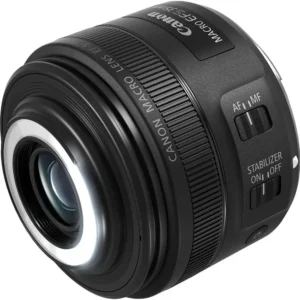 |
Canon EF-S 35mm Wide Angle Len For Food Photography |
|
|
|
 |
Tamron AF 90mm f/2.8 Lenses For Food Photography |
|
|
|
 |
Canon RF35mm F1.8 Lenses For Food Photos |
|
|
|
 |
Canon EF 24-70mm Best micro 4/3 lens for food photography |
|
|
|
 |
Nikon AF-S FX NIKKOR 50mm |
|
|
|
 |
Nikon AF-S DX Micro-NIKKOR 40mm |
|
|
|
 |
NIKON NIKKOR Z 50mm Best Lenses For Food Photography |
|
|
|
 |
Nikon PC-E FX Micro NIKKOR 45mm |
|
|
|
 |
Fujifilm XF55-200mm |
|
|
Best Lenses For Food Photography | 2026 Products Overview
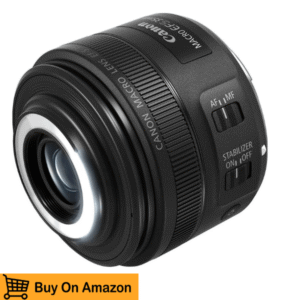
1. Canon EF-S 35mm Wide Angle Len For Food Photography
Product Overview:
Introduction
While a good camera body, proper lighting, and a refined artistic style are essential for compelling food photography, the choice of lens plays an equally critical role. Focal length, aperture, and macro capability directly influence composition, background separation, and detail rendering.
A widely accepted rule of thumb for food photography is to use a 50mm lens on a full-frame camera or a 35mm lens on a crop-sensor body. This focal length closely mimics natural human perspective, making food appear realistic and visually appealing.
The Canon EF-S 35mm f/2.8 Macro IS STM stands out as a compact, versatile prime lens designed specifically for APS-C Canon DSLRs. With its bright aperture, true 1:1 macro capability, and built-in Macro Lite, it is particularly well-suited for food, product, and close-up photography.
Key Features
-
Focal Length: 35mm (equivalent to approx. 56mm on APS-C)
-
Maximum Aperture: f/2.8
-
Lens Type: Fixed Prime Macro
-
Mount: Canon EF-S (APS-C only)
-
Image Stabilization: 4-stop Hybrid IS (angular + x-y shift correction)
-
Macro Capability: True 1.0x (1:1) magnification
-
Minimum Focusing Distance: 0.13m
-
Autofocus System: STM (Stepping Motor)
-
Built-in Macro Lite: Adjustable LED lighting
-
Weight: Approx. 190g
Benefits for Food Photography
-
Produces natural-looking compositions without distortion
-
Excellent background blur (bokeh) for isolating dishes
-
Performs well in low-light restaurant environments
-
Captures fine textures and details like spices, sauces, and garnishes
-
Lightweight and compact—ideal for long shooting sessions
Large-aperture lenses like this one are especially valuable when light is limited. The f/2.8 aperture allows more light to reach the sensor while also creating that soft, dreamy background often desired in food photography.
Lens Build Quality and Durability
Despite its compact size, the Canon EF-S 35mm f/2.8 Macro IS STM is solidly built and well-balanced. At just 190 grams, it feels comfortable on APS-C bodies without causing wrist fatigue.
The STM autofocus motor is fast, smooth, and ultra-quiet, making it equally useful for still photography and video work. While it lacks weather sealing, its durable construction is more than adequate for studio, indoor, and controlled outdoor shooting environments.
Focal Length Considerations for Food Photography
The 35mm focal length on a crop-sensor camera delivers a standard field of view, closely matching the classic 50mm look on full-frame cameras. This makes it ideal for:
-
Tabletop food shots
-
Flat lays
-
Lifestyle food photography
-
Restaurant interiors with dishes in context
Unlike wide-angle lenses, it avoids exaggerated perspective, and unlike telephoto lenses, it doesn’t require excessive distance from the subject.
Prime vs Zoom Lenses for Food Shots
Prime lenses, such as this 35mm macro, offer:
-
Sharper image quality
-
Wider maximum apertures
-
Better low-light performance
-
Creamier background blur
While zoom lenses provide framing flexibility and allow shooting from multiple angles without moving a tripod, they typically compromise on aperture and sharpness. For photographers who prioritize image quality and artistic depth, a prime lens remains the superior choice.
Macro Capability for Close-Up Food Shots
One of the biggest strengths of this lens is its true 1:1 macro reproduction ratio. This allows you to capture extreme close-ups of:
-
Food textures
-
Chocolate details
-
Coffee crema
-
Herbs, spices, and toppings
The built-in Macro Lite is especially useful at close focusing distances, where shadows are common. It provides controlled illumination without the need for external lighting accessories.
Compatibility with Camera Bodies
This lens is designed exclusively for Canon APS-C DSLR cameras with EF-S mount, including:
-
Canon EOS 70D, 80D, 90D
-
Canon EOS Rebel series (e.g., T7i, T8i)
-
Canon EOS SL and EOS 7D series
-
- Bright f/2.8 aperture for low-light photography and beautiful bokeh
- Hybrid image stabilization for sharp, clear images
- Built-in macro Lite for greater flexibility in controlling light
- 35mm standard angle of view for a wide range of photography applications
- Designed for APS-C DSLR cameras, making it a great option for those using this camera body.
- Not compatible with full-frame cameras
- The fixed focal length of 35mm may limit some photographers
- It is a bit more expensive than other lenses in the same category.
2. Tamron AF 90mm f/2.8 Lenses For Food Photography
Product Overview:

Introduction
Tamron’s 90mm macro lens has been a benchmark in close-up photography for decades, earning the trust of professionals and enthusiasts alike. The Tamron AF 90mm f/2.8 Di SP A/M 1:1 Macro Lens for Canon Digital SLR Cameras (Model 272EE) proudly continues this legacy by combining advanced optical engineering, classic macro performance, and reliable build quality. Designed for Canon EF mount cameras, it delivers outstanding results on both full-frame and APS-C bodies, making it a versatile choice for macro, portrait, nature, and detail-oriented photography.
Key Features
This lens features a sophisticated optical design incorporating LD (Low Dispersion) and XLD (eXtra Low Dispersion) glass elements to reduce chromatic aberration and enhance clarity. Dual coatings effectively suppress ghosting and flare, even in challenging lighting conditions. A hybrid image stabilization system compensates for both angular vibration and x-y shift, which is especially beneficial in handheld macro shooting. The lens offers a true 1:1 magnification ratio with a minimum focusing distance of just 0.3 meters, enabling life-size reproduction of small subjects.
Benefits
Photographers benefit from exceptional sharpness, accurate color reproduction, and reliable performance across a wide range of shooting scenarios. The 90mm focal length provides a comfortable working distance, allowing easier lighting and less disturbance to delicate or skittish subjects such as insects and flowers. Its versatility also makes it suitable for portraits, where the focal length and optical quality produce pleasing subject separation and fine detail.
Optical Performance
As part of Tamron’s SP (Super Performance) series, this lens is engineered to meet the demanding standards of professional photographers. The optical formula prioritizes resolution, contrast, and color fidelity, resulting in images that are crisp and highly detailed from center to edge. The lens performs consistently well in both macro and non-macro applications, reflecting Tamron’s long-standing expertise in optical design.
Sharpness and Image Quality
Sharpness is one of the standout strengths of this lens. At close focusing distances, it captures intricate textures and fine details with remarkable precision. Even at wider apertures, image quality remains strong, while stopping down further enhances edge-to-edge sharpness. This makes the lens ideal for scientific, naturalist, and commercial macro work where detail accuracy is critical.
Color Rendition and Contrast
The Tamron 90mm f/2.8 macro delivers natural, accurate color rendition with pleasing tonal transitions. Contrast is well-balanced, giving images a clean and vibrant look without appearing overly harsh. The advanced coatings help maintain strong contrast even when shooting in backlit conditions, ensuring colors remain true and saturated.
Aperture Performance (f/2.8)
With a maximum aperture of f/2.8, the lens offers flexibility in low-light situations and provides attractive background blur. The wide aperture is useful not only for macro work but also for portraits, where it produces smooth, creamy bokeh and helps isolate the subject from the background while maintaining excellent subject sharpness.
Build Quality and Durability
Built with durability in mind, the lens features a moisture- and dust-resistant construction suitable for outdoor use. The front element is coated with a fluorine layer that repels water, oil, and fingerprints, making it easier to clean and maintain. The solid construction reflects the professional-grade standards of the SP series, ensuring long-term reliability.
Compatibility with Camera Bodies
The Tamron AF 90mm f/2.8 Di SP A/M 1:1 Macro Lens is fully compatible with Canon EF mount digital SLR cameras, supporting both full-frame and APS-C sensors. It includes an AF/MF switch for quick transitions between autofocus and manual focus, offering greater control in demanding shooting situations. The package comes complete with a lens hood, front and rear caps, and a soft cover, making it ready for professional use straight out of the box.
- Superior resolution, chromatic correction, and coatings for high-image quality
- 90mm focal length is ideal for capturing intricate details and skittish subjects
- AF/MF system allows for quick switching between auto-focus and manual-focus
- Wide, well-textured focusing ring for smooth, precise manual focusing
- Tamron SP (Super Performance) series is a line of ultra-high-performance lenses
- Not compatible with cameras that use a different mount
- It is a bit expensive compared to other lenses in the same category
- It has a longer focal length than most of the other macro lenses available in the market.
3. Canon RF35mm F1.8 Lenses For Food Photos
Product Overview:

Introduction
The Canon RF 35mm f/1.8 Macro IS STM is a compact and versatile prime lens designed for Canon’s EOS R mirrorless cameras. With its wide-angle perspective, macro capability, and lightweight build, it is an excellent choice for food photography, everyday shooting, and close-up detail work.
Key Features
This lens features a 35mm focal length with a bright f/1.8 maximum aperture, a 0.5x macro magnification ratio, and a minimum focusing distance of 0.56 ft (0.17m). It includes Optical Image Stabilization offering up to 5 stops of shake correction, an STM autofocus motor, a customizable control ring, and a 12-pin communication system for enhanced camera-to-lens performance.
Benefits
The Canon RF 35mm f/1.8 offers a strong combination of portability, image quality, and creative flexibility. Its macro capability allows photographers to capture fine food details, while image stabilization and a fast aperture ensure consistent results in low-light indoor environments.
Focal Length Suitability for Food Photos
The 35mm focal length provides a natural and balanced field of view, making it ideal for food photography. It works well for table-top shots, flat lays, and lifestyle food scenes, allowing photographers to include surrounding elements without noticeable distortion.
Aperture Performance (f/1.8)
The wide f/1.8 aperture performs exceptionally well in low-light conditions and helps create attractive background blur. It allows food subjects to stand out clearly while maintaining a soft, pleasing separation from the background.
Depth of Field Control
This lens offers excellent depth-of-field control, especially when shooting close to the subject. It enables photographers to highlight specific details such as textures, ingredients, or garnishes while gently blurring other elements in the frame.
Sharpness and Image Quality
The Canon RF 35mm f/1.8 delivers impressive sharpness from edge to edge, even at wider apertures. Its Super Spectra coating helps reduce flare and ghosting, producing clean, high-contrast images with accurate and appealing color reproduction.
Autofocus Performance
Equipped with an STM motor and supported by the RF mount’s 12-pin communication system, autofocus performance is smooth, quiet, and precise. This makes the lens suitable for both still photography and video recording, including close-up food shots and preparation scenes.
Build Quality and Design
The lens is built with a solid yet compact design that feels reliable for everyday use. The integrated control ring allows direct adjustment of camera settings such as aperture or ISO, improving workflow efficiency while shooting.
Portability and Weight
Thanks to its lightweight and compact construction, the Canon RF 35mm f/1.8 is easy to carry and handle for extended shooting sessions. Its portability makes it especially suitable for food bloggers, travel photographers, and content creators.
Compatibility with Canon RF Camera Bodies
Designed specifically for the Canon RF mount, this lens is fully compatible with EOS R series cameras. The advanced communication system ensures seamless integration, fast performance, and access to in-camera corrections for optimal image quality.
- Compact design that is perfect for everyday photography and macro photography
- 0.5x Magnification Ratio and a minimum focusing distance of 0.56 ft. or 0.17M for capturing intricate details and small subjects
- Control ring for direct setting changes, making it easy to adjust settings while shooting
- Optical image stabilization for sharp and stable images in low-light conditions
- 12-pin Communication System for fast and accurate focusing and control directly from the camera’s menu
- Only compatible with EOS R series cameras
- May be too specialized for some photographers
- Some users may find the control ring too sensitive
4. Canon EF 24-70mm Best micro 4/3 lens for food photography
Product Overview:

Introduction
The Canon 24–70mm f/4L IS USM is a professional-grade standard zoom lens designed for photographers who need flexibility, reliability, and consistent image quality. Whether used on Canon RF mount cameras (RF version) or Canon EF DSLRs (EF version), this L-series lens is a strong option for food photography thanks to its versatile zoom range, close-focusing ability, and excellent optical performance.
Key Features
This lens offers a 24–70mm focal length range with a constant f/4 maximum aperture, advanced optical construction with aspherical and UD elements, and a close focusing distance of just 1.25 ft (0.38m). It includes a dedicated macro mode with up to 0.7x magnification, Optical Image Stabilization providing up to 4 stops of correction, and a fast, silent USM autofocus system. The Hybrid IS system compensates for both angular and shift camera movements, making it especially useful for close-up and handheld shooting.
Benefits
The Canon 24–70mm f/4L IS USM combines zoom versatility with near-macro capability, reducing the need to switch lenses during food shoots. Its stabilization system helps achieve sharp images in low-light kitchens or restaurants, while L-series optics ensure consistent color, contrast, and clarity across different compositions.
Zoom Range Versatility (24–70mm)
The 24–70mm zoom range makes this lens extremely versatile for food photography. At the wide end, it works well for table spreads, restaurant interiors, and storytelling shots. At the telephoto end, it allows tighter framing of dishes, ingredients, and details without changing your shooting position.
Focal Length Suitability for Food Photos
For food photography, this focal range covers almost every common scenario. Wide focal lengths are ideal for flat lays and environmental food shots, while mid-to-telephoto focal lengths are perfect for isolating plates, drinks, and textures with minimal distortion.
Aperture Performance
With a constant f/4 aperture, the lens delivers consistent exposure throughout the zoom range. While not as shallow as f/2.8 primes, it still provides pleasing background separation, especially when combined with the lens’s close-focusing and macro capabilities.
Sharpness and Image Quality
Image quality is excellent across the entire zoom range. The combination of aspherical and UD elements minimizes chromatic aberration and distortion, producing sharp, high-contrast images with accurate colors—an essential requirement for professional food photography.
Autofocus Performance
The USM autofocus system is fast, accurate, and virtually silent. This ensures precise focusing on food details, even in close-up or macro mode, and makes the lens suitable for both still photography and video content creation.
Build Quality and Durability
As part of Canon’s L-series, the lens features a robust construction designed for professional use. It offers weather sealing against dust and moisture, making it dependable for both studio and on-location food shoots.
Handling and Ergonomics
The lens is well-balanced on both DSLR and mirrorless bodies. The zoom and focus rings are smooth and responsive, and the one-touch macro switch allows quick access to close-up shooting without interrupting workflow.
Portability and Weight
Compared to faster f/2.8 zooms, the Canon 24–70mm f/4L IS USM is relatively compact and lightweight. This makes it comfortable to use during long shooting sessions and easy to carry for food bloggers, travel photographers, and content creators.
The lens also has two types of aspherical elements, which help to improve image quality and reduce distortion. The lens also has a 9-blade circular diaphragm, which delivers beautiful, soft backgrounds. It is also built to be durable, with a dust and water-resistant design, as well as a fluorine coating on the front and rear elements that reduces smears and fingerprints. Compact and lightweight, this lens is the perfect L-series lens for photographers on the go.
- Superior image quality: With 2 aspheric and 2 UD elements, the lens delivers high-quality images with excellent detail throughout the entire zoom range.
- Macro mode: The lens offers a macro mode at the telephoto end with up to 0.7x magnification, making it ideal for close-up shots.
- Image stabilization: The lens features a Hybrid IS system with up to 4 stops of stabilization, providing effective stabilization even in macro photography.
- Fast and quiet autofocus: The lens features a ring-type USM that delivers fast and quiet autofocus, making it ideal for capturing fast-moving subjects.
- Durable and dust-resistant: The lens is sealed for excellent dust and water resistance, making it ideal for use in challenging environments.
- Not suitable for low-light conditions: The maximum aperture of f/4.0 may not be ideal for low-light photography.
- Heavy: The lens may be too heavy for some photographers to carry around for extended periods of time.
- Not suitable for APS-C cameras: This lens is designed for full-frame cameras, and may not be compatible with APS-C cameras.
5. Nikon AF-S FX NIKKOR 50mm
Product Overview:

Introduction
The Nikon AF-S FX NIKKOR 50mm f/1.4G is a high-performance prime lens designed for Nikon F-mount FX and DX DSLRs. Known for its exceptional optical quality and versatility, this lens is ideal for portraits, low-light photography, and everyday shooting, offering photographers a classic 50mm perspective with professional-level results.
Key Features
-
50mm prime focal length for natural perspective
-
Fast f/1.4 maximum aperture for low-light performance and shallow depth of field
-
Minimum aperture of f/16 for extended depth-of-field control
-
Ultrasonic AF motor (AF-S) for fast, quiet autofocus
-
Full-time manual focus override
-
Minimum focusing distance of 0.45m (17.72 inches)
-
58mm filter thread
-
Included HB-47 lens hood for protection
-
Aspherical lens element to reduce aberrations and maintain image quality
Benefits
The Nikon 50mm f/1.4G provides excellent low-light capability, beautiful background separation, and sharp image quality. Its compact and lightweight design makes it portable, while the wide aperture ensures creative flexibility, allowing photographers to achieve professional-looking bokeh and precise focus control.
Aperture Performance
With a fast f/1.4 maximum aperture, this lens excels in low-light situations and allows for a shallow depth of field. The aperture enables photographers to isolate subjects with creamy, pleasing bokeh, making it ideal for portraits, food photography, and artistic shots.
Focal Length Suitability for Photography
The 50mm focal length offers a natural field of view that closely resembles human vision, making it highly versatile for everyday photography, portraiture, and street photography. It works well on both FX and DX cameras, providing effective focal lengths that suit a wide range of subjects.
Sharpness and Image Quality
The lens delivers crisp, high-resolution images across the frame. The inclusion of an aspherical element reduces chromatic aberration and distortion, ensuring sharpness and accurate color reproduction even at wide apertures. The results are consistently clean and professional-looking.
Autofocus Performance
The AF-S motor provides fast, quiet, and precise autofocus, which is especially useful for portraits and low-light shooting. Full-time manual focus override allows photographers to fine-tune focus without switching modes, offering enhanced control over critical shots.
Build Quality and Durability
Constructed with Nikon’s high standards, the lens is solid yet lightweight. It is designed for reliable performance in various conditions, and the included HB-47 lens hood offers additional protection from stray light and physical impact.
Portability and Weight
The lens is compact and relatively lightweight, making it easy to carry for extended shooting sessions. Its portability ensures it is suitable for travel, street photography, and professional work without causing fatigue.
Compatibility with Nikon Camera Bodies
The AF-S FX NIKKOR 50mm f/1.4G is fully compatible with Nikon FX and DX DSLR cameras. On DX bodies, it provides an effective focal length of approximately 75mm, making it ideal for tighter framing and portrait work while maintaining full compatibility with Nikon’s F-mount system.
- A fast f/1.4 aperture allows for shallow depth-of-field and low-light photography.
- Ultrasonic-type AF motor with full-time manual focusing for unparalleled autofocus performance.
- Aspherical lens elements minimize coma and other types of lens aberrations.
- The minimum focus distance of 0.45m/17.72 inches.
- Nikon F mount for FX and DX DSLRs.
- Not zoomable.
- May be considered pricey for some photographers.
- The lens hood is sold separately.
6. Nikon AF-S DX Micro-NIKKOR 40mm
Product Overview:

Introduction
The Nikon AF-S DX Micro-NIKKOR 40mm f/2.8G is a compact and lightweight DX-format macro lens designed for Nikon digital SLRs. Ideal for close-up and macro photography, it combines portability with impressive optical performance, making it a versatile tool for photographers capturing detailed subjects such as flowers, collectibles, food, and small products.
Key Features
-
40mm prime focal length optimized for DX-format cameras
-
Maximum aperture of f/2.8 for low-light shooting and depth-of-field control
-
1:1 life-size macro reproduction ratio
-
Close-Range Correction (CRC) system for superior close-up performance
-
Silent Wave Motor (SWM) for quiet and precise autofocus
-
Compact and lightweight design for portability
-
M/A mode for instant switching between autofocus and manual focus
-
Focus distance indicator from 0.53 ft to infinity
Benefits
This lens provides high-quality macro and close-up performance in a portable form factor. Its 1:1 reproduction ratio allows photographers to capture fine details with clarity, while the fast f/2.8 aperture offers creative control over depth of field and excellent performance in low-light conditions. The CRC system ensures sharpness even at very close distances.
Focal Length Suitability for Photography
The 40mm focal length provides a natural perspective for close-up and general photography. On DX-format cameras, it delivers a versatile field of view suitable for macro subjects, portraits, and small-scale tabletop photography.
Macro and Close-Up Capability
With a maximum 1:1 reproduction ratio and a minimum focus distance of 0.53 ft (16cm), the lens excels at capturing fine details. The CRC system enhances image quality at close distances, minimizing aberrations and maintaining sharpness throughout the frame.
Aperture Performance
The fast f/2.8 aperture allows for excellent low-light performance and creative background separation. It provides a pleasing shallow depth of field for isolating subjects in macro and portrait photography.
Depth of Field Control
Combined with its wide aperture and close focusing ability, this lens offers precise depth-of-field control. Photographers can achieve smooth background blur, emphasizing intricate textures and details in macro compositions.
Sharpness and Image Quality
The lens is constructed with 9 elements in 7 groups, delivering sharp and clear images from infinity to life-size magnification. The optical design, along with the CRC system, ensures minimal chromatic aberration and high contrast, producing professional-quality results.
Build Quality and Durability
The Nikon 40mm f/2.8G is built to be lightweight yet robust. Its compact design and quality materials make it suitable for frequent use in both studio and outdoor environments. The SWM system adds durability and smooth performance over time.
Portability and Weight
Thanks to its small size and lightweight construction, this lens is highly portable, making it ideal for travel, fieldwork, and extended shooting sessions without causing fatigue.
Compatibility with Nikon DX Camera Bodies
The lens is fully compatible with Nikon DX-format DSLRs and optimized for digital sensors. Its focal length and macro capabilities make it a versatile choice for DX users seeking a high-performing macro lens for a variety of subjects.
This lens is an excellent option for photographers who want a compact, high-quality macro lens capable of capturing intricate details with precision and clarity.
- Compact and lightweight design, making it easy to carry around.
- Provides high resolution and contrast from infinity to life-size (1X)
- Specially designed and optimized for Nikon digital SLRs
- Built-in Silent wave motor (SWM) for ultra-fast and ultra-quiet operation
- Dust and Waterproof rubber sealing mount for added durability
- Not zoomable
- Only compatible with Nikon F (DX) mount
- The focal length is fixed at 40mm
7. NIKON NIKKOR Z 50mm Best Lenses For Food Photography

Product Overview:
Introduction
The Nikon NIKKOR Z 50mm f/1.8 S is a premium fast prime lens designed for Nikon Z mirrorless cameras. With its 50mm focal length and wide f/1.8 aperture, the lens is ideal for food photography, portraits, and everyday shooting, offering exceptional sharpness, minimal distortion, and pleasing background blur.
Key Features
-
50mm prime focal length for natural perspective
-
Fast f/1.8 maximum aperture for low-light performance and shallow depth of field
-
Ultra-quiet stepping motor (STM) for smooth and silent autofocus
-
Beautiful bokeh rendering
-
5-Axis Dual Detect Optical VR (with compatible Z cameras)
-
Compact and lightweight monocoque body design
-
Tilting Vari-angle LCD display for flexible composition
-
Compatible with F-mount NIKKOR lenses via FTZ Mount Adapter (sold separately)
Benefits
This lens delivers sharp, high-quality images with rich colors and smooth background blur, making it perfect for food photography. Its fast aperture allows shooting in low-light environments, while the quiet autofocus ensures minimal distraction during shooting. The compact design enhances portability and versatility for photographers on the move.
Focal Length Suitability for Food Photography
The 50mm focal length provides a natural perspective for food photography. It is ideal for capturing individual dishes, flat lays, and detailed shots of ingredients, offering a balanced field of view without noticeable distortion.
Aperture Performance
The f/1.8 maximum aperture ensures excellent low-light performance and creative control over depth of field. It allows food subjects to stand out sharply against a softly blurred background, enhancing visual appeal.
Depth of Field Control
With its wide aperture and precise optics, the lens offers excellent depth-of-field control. Photographers can isolate key elements of a dish, create smooth bokeh, and emphasize textures and details in their compositions.
Color Rendition and Contrast
The lens delivers vivid and accurate colors with high contrast, maintaining the natural appearance of food. Its optical design ensures consistent color reproduction across the frame, making dishes look appetizing and visually striking.
Autofocus Performance
Equipped with a stepping motor, autofocus is fast, smooth, and silent, making it ideal for stills and video. It enables precise focusing on intricate food details without distracting camera noise.
Build Quality and Durability
The NIKKOR Z 50mm f/1.8 S features a durable monocoque body design that is both lightweight and robust. It is built to withstand regular use while maintaining consistent performance and reliability.
Handling and Ergonomics
The lens is compact and easy to handle, with intuitive control and a comfortable grip. The tilting Vari-angle LCD display enhances composition flexibility, allowing shots from various angles, especially useful for tabletop and overhead food photography.
Portability and Weight
Lightweight and compact, this lens is easy to carry during extended shooting sessions, making it suitable for food bloggers, content creators, and travel photographers who require mobility without sacrificing quality.
Compatibility with Nikon Z Mount Cameras
Designed for Nikon Z mount mirrorless cameras, the lens integrates seamlessly with the system. It is also compatible with F-mount NIKKOR lenses using the FTZ Mount Adapter, expanding versatility for photographers with existing Nikon lens collections.
The Nikon NIKKOR Z 50mm f/1.8 S combines exceptional sharpness, beautiful bokeh, and low-light performance, making it an outstanding choice for food photographers seeking professional-quality results in a compact and versatile lens.
- The lens has an f/1.8 maximum aperture, which allows for great low-light performance and beautiful bokeh.
- It is extremely sharp across the entire frame and has virtually zero distortion, even when shot wide open.
- The lens has a new ultra-quiet stepping motor for silent focusing.
- It is compatible with F-mount NIKKOR lenses using the FTZ mount adapter (sold separately), providing more versatility for photographers
- The lens is designed with 5-Axis Dual to detect optical VR for image stabilization and a compact, lightweight, slim unibody design.
- The lens is not zoomable, which can be a limitation for some photographers.
- The lens is relatively expensive, which may not be affordable for all photographers.
- The lens doesn’t have an Image Stabilization mechanism built-in, depending on the camera body for image stabilization.
8. Nikon PC-E FX Micro NIKKOR 45mm
Product Overview:

Introduction
The Nikon PC-E FX Micro NIKKOR 45mm f/2.8D ED is a high-performance perspective control lens designed for FX-format Nikon DSLRs. With its 45mm focal length, f/2.8 maximum aperture, and advanced tilt-shift capabilities, this lens provides photographers with precise control over perspective, depth of field, and composition, making it ideal for architectural, product, and commercial photography.
Key Features
-
45mm prime focal length with f/2.8 maximum aperture
-
Perspective control with ±11.5mm shift and ±8.5° tilt
-
90° rotation in either direction for versatile composition
-
Extra-low Dispersion (ED) glass for reduced chromatic aberration
-
Nano Crystal Coat and Super Integrated Coating (SIC) for minimized flare and ghosting
-
Rounded 9-blade diaphragm for smooth bokeh
-
Compact design: 3.2 inches in diameter, 4.4 inches in length
Benefits
This lens allows photographers to correct perspective distortion, maintain straight lines in architectural shots, and achieve creative effects with tilt and shift. Its ED glass and advanced coatings ensure superior sharpness, contrast, and color fidelity, while the compact size makes it easy to handle during fieldwork.
Focal Length Suitability for Photography
The 45mm focal length provides a natural field of view, making it versatile for architecture, interiors, product photography, and close-up detail work. It balances wide-angle coverage with minimal distortion, ideal for capturing realistic perspectives.
Tilt-Shift and Perspective Control Features
With ±11.5mm shift and ±8.5° tilt, along with 90° rotation, photographers can precisely control perspective and plane of focus. This allows correction of converging lines in architectural shots and creative selective focus in product and still-life photography.
Macro and Close-Up Capability
While primarily a perspective control lens, its close focusing capability allows detailed shots of smaller subjects. The lens is suitable for capturing product details, intricate textures, and still-life compositions with enhanced control over focus and perspective.
Aperture Performance
The f/2.8 maximum aperture provides good low-light performance and allows moderate background separation. Combined with the 9-blade rounded diaphragm, it produces smooth and aesthetically pleasing out-of-focus areas.
Depth of Field Control
The tilt function gives precise control over the plane of focus, enabling selective focus and extended depth of field in creative compositions. Photographers can achieve sharpness across angled subjects without relying solely on small apertures.
Sharpness and Image Quality
Constructed with ED glass and featuring Nikon’s Nano Crystal Coat and SIC, the lens delivers exceptional sharpness, accurate color reproduction, and minimal chromatic aberration. Image quality remains consistent across the frame, even when using tilt and shift functions.
Build Quality and Durability
The lens is robustly built, combining high-quality materials with precision engineering. Its compact form factor enhances portability without sacrificing durability, making it suitable for professional use in studios and on-location shoots.
Portability and Weight
Measuring 3.2 inches in diameter and 4.4 inches in length, the lens is compact for a tilt-shift design. Its relatively lightweight construction makes it manageable for handheld work and transport, ideal for photographers who need mobility with advanced control.
The Nikon PC-E FX Micro NIKKOR 45mm f/2.8D ED is a versatile and powerful lens, offering creative perspective control, excellent optical performance, and durable construction, making it a top choice for architecture, commercial, and product photography.
- Provides exceptional perspective control with the ability to tilt, shift, and rotate while shooting.
- Wide shifting range of plus or minus 11.5mm and tilting range of plus or minus 8.5 degrees.
- Built using Extra-low Dispersion (ED) glass elements for superior sharpness and color correction.
- Nikon’s Nano Crystal Coat virtually eliminates internal reflections for greater image clarity.
- Auto-aperture control with an electromagnetic diaphragm for accurate exposure control.
- It is relatively expensive.
- It is not a zoom lens, which may limit its versatility.
- It may be difficult to use for beginners.
9. Fujifilm XF55-200mm
Product Overview:

Introduction
The Fujifilm XF55-200mm F3.5-4.8 R LM OIS is a versatile telephoto zoom lens designed for Fujifilm X series mirrorless cameras. Offering an extended focal length range, this lens is ideal for capturing distant subjects, wildlife, sports, and portrait photography with clarity and precision.
Key Features
-
55-200mm focal length (equivalent to 83-300mm on APS-C cameras)
-
Maximum aperture of F3.5-4.8 and minimum aperture of F22
-
Stepper-type AF motor for fast, quiet autofocus
-
Optical Image Stabilization (OIS) providing up to 4.5 stops of shake correction
-
Minimum focusing distance of 1.10m (43.41 inches)
-
62mm filter thread for creative filter use
-
Metal construction focus and aperture rings for durability and precision
-
Compact and lightweight design suitable for handheld shooting
Benefits
This lens offers excellent telephoto reach in a compact package, allowing photographers to capture distant subjects without compromising image quality. Its image stabilization and fast autofocus ensure sharp images even in low-light conditions or at long focal lengths. The lens is well-suited for wildlife, sports, and portrait photography.
Zoom Range Versatility (55–200mm)
The 55-200mm zoom range provides flexibility for both mid-telephoto and long-telephoto shots. It allows photographers to frame subjects tightly, capture detailed distant objects, or compress perspective for creative compositions.
Focal Length Suitability for Photography
With an effective focal length of 83-300mm on APS-C cameras, this lens is ideal for portraits, wildlife, and sports photography. The range also works well for capturing environmental details and isolated subjects from a distance.
Aperture Performance
The variable maximum aperture of F3.5-4.8 delivers decent low-light performance, while the minimum aperture of F22 allows extended depth of field for detailed compositions. The lens balances brightness and compact design, making it versatile for everyday shooting.
Image Stabilization
The built-in optical image stabilization provides up to 4.5 stops of shake correction. This feature is especially beneficial for handheld telephoto shots, reducing blur caused by camera shake and enabling slower shutter speeds in challenging lighting.
Autofocus Performance
The stepper motor ensures fast, accurate, and quiet autofocus, making it suitable for capturing moving subjects, candid moments, and video recording without noticeable focusing noise.
Sharpness and Image Quality
The XF55-200mm lens delivers sharp images with good contrast and color fidelity across the zoom range. While minor softening may occur at maximum zoom and wide-open apertures, overall image quality is excellent for telephoto applications.
Build Quality and Durability
Constructed with metal focus and aperture rings, the lens feels solid and reliable. The design includes intuitive control switches and durable materials, making it a dependable choice for extended field use.
Portability and Weight
Despite its telephoto capabilities, the lens is relatively lightweight and compact for a 55-200mm zoom. This makes it comfortable for handheld shooting, travel, and extended outdoor photography sessions.
The Fujifilm XF55-200mm F3.5-4.8 R LM OIS is a versatile, high-quality telephoto zoom lens, offering excellent reach, image stabilization, and sharpness, making it an ideal companion for Fujifilm X series photographers seeking extended focal length performance.
- Fast F3.5-4.8 maximum aperture which produces sharp images across the entire zoom range.
- Image stabilization function enables the use of shutter speeds up to 4.5 stops slower, preventing camera shake even in low light situations or when shooting at a stopped-down aperture.
- High-speed AF of 0.28 seconds, allowing you to quickly focus on your subject.
- High-quality metal design for easy transport and outstanding mobility and performance.
- Two ED lens elements and one Super ED lens element for increased performance and effective control against chromatic aberrations.
- May not be suitable for wide-angle shots
- A switch on the side of the lens is required to activate image stabilization
- Some users may find the minimum focus distance of 1.1m limiting for telephoto close-ups
How To Choose The Best lens for food photography | Ultimate Buyer’s Guide 2026
It is recommended to photograph a cooked meal at an f/1.8, f/2.4 or f/3.5 aperture. With this fairly small depth of field margins, the dishes or food will be well detached from the background of the photo, which will be blurred.
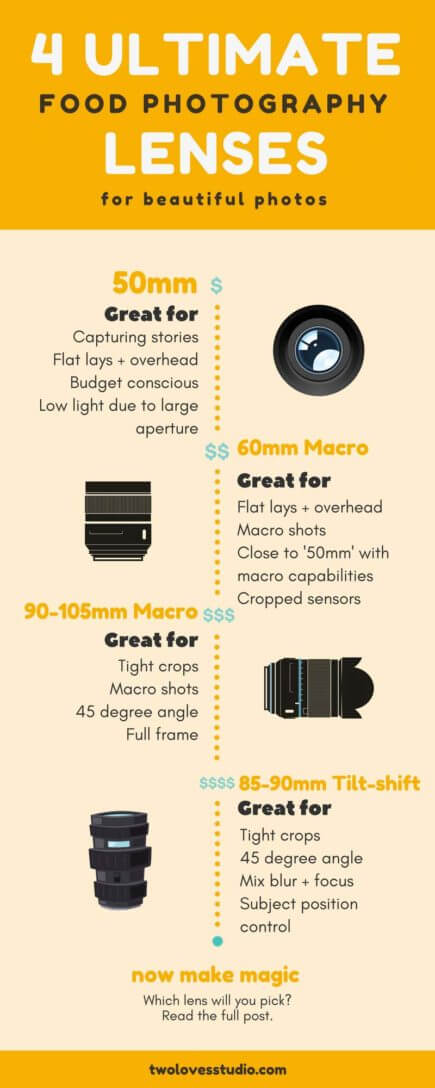
50mm Prime Lens: Quality on a Budget
 The 50mm lens can also be a useful lens, especially if you don’t have a zoom. This lens is good for top-down food photography and tablescapes.
The 50mm f/1.8 is often referred to as the “clever fifty” because it gives you decent results for a very low price. If you’re just starting out and your budget is tight, get this.For food photography, 50mm is actually considered a wide-angle lens. If you’re shooting just an item or two in a straight line or at a 3/4 angle, you’ll have too much background and surface in your frame.
You need to have large backgrounds if you use the lens this way. Compare images of Shaved Broccoli Salad below.
The one on the left is at 50 mm. You can see that the background does not fill the entire frame. You can also see the edge of the surface. The food is too far away to really see the inside of the plate.
I did the shot on the right at 60mm. I did not move the camera or the tripod. You can see that the extra 10mm makes a big difference.
Get closer with the 24-70mm zoom lens
 Although primes are ideal, it’s helpful to have a zoom lens, such as a 24-70mm f/2.8 or 24-105mm f/4
I have both on the Canon L-series and find the 24-70mm much sharper than the 24-105mm. The 24-105mm lens is kit when you buy a Canon 5D.
Yes, the 24-70mm is a zoom lens, but I find it very sharp compared to most zoom lenses. Many food photographers consider it a staple in their kit.
60mm macro lens: for less distortion
 A 60mm macro is a great option if you shoot with a cropped frame sensor.
On a cropped sensor, it’s more like having a 100mm sensor. If you upgrade to full frame, you can use it like you would a 50mm. This lens will allow you to get 3/4 angle view shots of your subject with beautiful bokeh.You also won’t get the distortion at this angle that you would when shooting with a wider focal length such as 50mm.
100/110mm macro: for portrait-style food shots
 A great lens to have in your kit is a 100mm macro lens. This lens is not just for macro or close-ups. By moving further away from your set, you can also get beautiful portrait-style shots. You will get a great blurred background.
I have the consumer-grade 100mm f/2.8 and it is very sharp. In fact, I’ve read reviews where the photographer preferred the consumer-grade to the 100mm macro on the L-Series. And it’s half the cost.
If you go for the 100mm/105mm macro lens on a cropped frame sensor, you’ll be shooting at a 150mm focal length. This will be a very tight crop. Especially if space is an issue, or if you have multiple props or a narrative aspect to your images.
80mm Prime Lens: For Wider Scenes
This probably won’t be one of the main goals of your kit. But if you already have a pair of lenses for your full-frame, like a 100mm macro and a 50mm or 24-70mm, consider the 80mm prime lens.
This is a good lens for food photography and shooting wider scenes, but not as wide as you would with a 50mm.
I do a lot of food portraits. And sometimes I find that shooting at 70mm is not close enough. But the 100mm gets me too close.
Also, when you shoot wide open, say at 70mm on a 24-70mm lens, you risk more distortion. Zoom lenses typically work best somewhere in the middle of their available focal lengths.
85mm / 90mm Tilt-Shift – For the best angle
The price is restrictive for many photographers. But I need to mention a tilt-shift lens for your food photography. You can always rent one if you can’t afford to buy one.
This is a lens used by food photographers in the advertising world.
A tilt-shift lens allows you to control the plane of focus very precisely. You can move the lens up or down, left or right, to minimize distortion.
Tilt features allow you to keep different items in focus at different focal planes.
You can focus on the subject sharply with a very blurred background.
When you focus at a certain angle, everything at that angle will be in focus.
With this lens, you can shoot food at the best angle. You also control how many of the props or how much of the larger story appears within the frame. All without changing the angle or distance of the camera.
It’s a fantastic lens and once you’ve worked with the one you’ll be amazed.
Best Lenses For Food Photography | Infographics
BEST LENS FOR FOOD PHOTOGRAPHY | Video Explanation
Frequently asked questions about food photography lenses
What is the best Canon lens for food photography?
The best Canon lenses for food photography depend on your camera mount and your preferences. For full-frame mirrorless Canon cameras, many food photographers choose the Canon RF 35mm f/1.8 Macro IS STM. Digital SLR photographers looking for a zoom lens should consider the Canon EF 24-70mm f/4L IS USM.
What is the best focal length for food photography?
The best focal length for food photography is 50-90mm (full-frame equivalent).
The 50-90mm focal length has excellent compositional value, with a compressed angle of view and few background elements. Coincidentally, the 50-90mm focal length range is also the best area for portrait photography.
Is 35mm suitable for food photography?
The 35mm focal length is ideal for journalistic food photography; at 35mm, the background is not too obtrusive and provides enough compression to bring the food to the foreground.
Which Nikon lenses are best for food photography?
Photographers shooting food with a Nikon DX cropped camera are recommended to use the Nikon AF-S DX 40mm f/2.8G Microlens for sharp images.
The Tamron SP 90mm F2.8 Di Macro VC USD is the best lens for shooting food on a full-size camera. It provides excellent image quality even in low light conditions.
Is the 18-55mm lens suitable for food photography?
Beginning food photographers need a great lens, and they should consider using the 18-55mm lens from the kit lens that came with the camera. Kit lenses are often underestimated.
The 18mm wide-angle lens is ideal for taking close-ups, and the 55mm long-focus lens is ideal for aerial shots with minimal background elements, making it the best lens for food photography for beginners.
How to take a good food photo?
Above all, to get beautiful photos, it’s not all about the camera, or the lens to be used on its case. A few conditions are necessary to obtain beautiful photos of the foods you want to photograph.
Natural lighting
In food photography, there’s nothing better than using natural light. It is therefore important to choose the place and time to take the photo.
Aperture Priority
For the photographic mode to use, put yourself in Aperture Priority mode to better manage the brightness of your camera. This allows you to focus well to get beautiful photos, without exposing them to direct light.
Polished images
In the era of digital marketing, it’s all about image. Food photos are no exception. Thus, it is necessary to take good care of the composition of the image of the dishes to be photographed.
To conclude:
Choosing the best lens for food photography is not easy. Before you buy, you should always consider the type of photos you want to take.
If you are working in a studio, you often have more space, so a longer focal length will be more appropriate. Also, you can control the lighting, so a narrow f-number aperture is not a big problem.
On the other hand, if you’re working outdoors, you’ll be visiting kitchens with a variety of conditions, so a versatile lens is a must.
Finally, don’t forget to consider your budget. Our recommended lenses cost anywhere from under $400 to over $2,500, so if a lens is important to you, there’s no need to limit your spending. The size of your investment should always be related to your level of experience. Are you a beginner or do you already have a professional job? If you do food photography for a living, a high-end lens is worth considering. Otherwise, stick with the less expensive ones.
That’s up to you.
What kind of food photography lenses are you thinking of buying? And do you have any recommendations? Let us know your thoughts in the comments.
FAQs
Is 50mm Or 35mm Better For Food Photography?
Both 50mm and 35mm lenses can be great for food photography, but the choice ultimately depends on the look and style you want to achieve.
A 50mm lens is a classic choice for food photography, as it produces a natural-looking field of view that is similar to what we see with our own eyes. This makes it great for capturing food at eye level, and it also has a shallow depth of field that can help to isolate the subject and create a pleasing bokeh effect.
On the other hand, a 35mm lens is wider, which can be useful if you want to capture more of the surroundings in your shots. It can be good for overhead shots, and can also be useful in tight spaces where it’s difficult to move further back from your subject. The wider field of view can make your images feel more spacious and airy.
In the end, it comes down to personal preference and the style you want to achieve. If you’re unsure, you can try both lenses and see which one you prefer for your particular style of food photography.
Is 24 70 Lens Good For Food Photography?
A 24-70mm lens can be good for food photography, but it may not be the best choice for all situations. The 24-70mm lens is a versatile zoom lens that can be used for a wide range of photography genres, including portraits, landscapes, and events.
In terms of food photography, the 24-70mm lens can be useful for capturing a variety of shots, including wide-angle shots of the entire scene, as well as tighter shots of individual dishes. However, its focal range may not be ideal for getting the shallow depth of field and bokeh effect that many food photographers prefer, especially for close-up shots of food.
A prime lens, such as a 50mm or 35mm, is often a popular choice for food photography because it has a wider aperture and can create a shallower depth of field, which helps to isolate the subject and create a pleasing bokeh effect. However, if you’re looking for a more versatile lens that can be used for a variety of photography genres, including food photography, then a 24-70mm lens can be a good choice.
Ultimately, the best lens for food photography will depend on your specific needs and preferences, as well as the style of food photography that you’re looking to achieve.
What Is The Best Macro Lens For Food Photography?
There are several good macro lenses for food photography, each with its own strengths and weaknesses. Here are a few options to consider:
- Canon EF 100mm f/2.8L IS USM Macro Lens: This is a popular choice among food photographers, and for good reason. It offers excellent image quality, a wide aperture for a shallow depth of field, and optical image stabilization to reduce camera shake.
- Nikon AF-S VR Micro-NIKKOR 105mm f/2.8G IF-ED Lens: This lens is known for its sharpness and clarity, and also offers a wide aperture for a shallow depth of field. It also has Vibration Reduction technology to minimize camera shake.
- Sony FE 90mm f/2.8 Macro G OSS Lens: This lens is designed specifically for Sony mirrorless cameras and offers excellent image quality, fast and accurate autofocus, and optical image stabilization.
- Tamron SP 90mm f/2.8 Di Macro 1:1 VC USD Lens: This lens is known for its sharpness and fast autofocus, and also has Vibration Compensation technology to minimize camera shake. It is available for Canon, Nikon, and Sony cameras.
All of these lenses are great options for food photography and offer a true 1:1 magnification ratio for extreme close-up shots. Ultimately, the best macro lens for food photography will depend on your specific needs and preferences, as well as the camera system you are using.
Is A 35 Mm Lens Good For Food Photography?
Yes, a 35mm lens can be good for food photography, especially if you want to capture wider shots of the food and its surroundings. A 35mm lens is considered a wide-angle lens, which means it has a wider field of view than a standard 50mm lens and can capture more of the scene in a single frame.
A wider field of view can be useful for capturing the entire scene, including the table setting, background, and other elements that can help tell a story and set the mood for the photograph. Additionally, a 35mm lens can help you create a sense of depth and dimension in your photographs, making the food look more inviting and appetizing.
That being said, a 35mm lens may not be the best choice for extreme close-up shots of the food, which may require a macro lens or a longer focal length. A 35mm lens may also produce some distortion, especially when shooting at close distances, so it’s important to be mindful of the composition and framing of your shots.
Overall, a 35mm lens can be a great choice for food photography, especially if you want to capture wider shots of the food and its surroundings.
Why Is 35mm So Popular?
The 35mm focal length has been a popular choice among photographers for many years for several reasons:
- Versatility: The 35mm lens is a versatile option that can be used for a wide range of photography genres, including street photography, landscape, travel, and even some types of portrait photography. It is a great all-purpose lens that can be used in a variety of shooting scenarios.
- Wider Field of View: A 35mm lens has a wider field of view than a standard 50mm lens, which means it can capture more of the scene in a single frame. This makes it a great option for landscape and architectural photography, as well as for capturing group shots and environmental portraits.
- Lightweight and Compact: 35mm lenses are often lightweight and compact, which makes them easy to carry around and ideal for travel and street photography. They are also often less expensive than other lenses, making them a great option for beginners or those on a budget.
- Sharpness and Image Quality: Many 35mm lenses are known for their sharpness and image quality, which can help to produce clear and vibrant images with plenty of detail.
Overall, the 35mm focal length offers a great combination of versatility, wider field of view, portability, and image quality, making it a popular choice among many photographers.
Can I Use 85mm For Food Photography?
Yes, you can use an 85mm lens for food photography, but it may not be the best choice for all situations. An 85mm lens is considered a portrait lens and is often used for portraiture because it can create a shallow depth of field and a pleasing bokeh effect.
In terms of food photography, an 85mm lens can be useful for capturing close-up shots of individual dishes, which can help to create a sense of intimacy and detail. However, it may not be the best choice for capturing wider shots of the entire scene, as it has a narrower field of view than a 35mm or 50mm lens.
If you do choose to use an 85mm lens for food photography, you’ll want to be mindful of the aperture settings, as a wider aperture can create a shallow depth of field, which may not be ideal for capturing the entire dish in focus. You may also want to experiment with the distance between the camera and the subject to ensure that you’re able to capture the details of the food without distortion.
Overall, an 85mm lens can be a useful tool for food photography, especially for close-up shots of individual dishes, but it may not be the best choice for capturing wider shots of the entire scene.
What Is A 70 300 Mm Lens Used For?
A 70-300mm lens is a telephoto zoom lens that can be used for a variety of photography genres, including wildlife, sports, portrait, and landscape photography.
Here are some common uses for a 70-300mm lens:
- Wildlife Photography: The 70-300mm lens is a popular choice among wildlife photographers, as it allows them to get close to animals without disturbing them. The long focal length also makes it easier to fill the frame with the subject, capturing detail and texture.
- Sports Photography: A 70-300mm lens is also a great option for sports photography, as it allows you to capture the action from a distance. The long focal length allows you to zoom in on the athletes and freeze the action, while the wide aperture helps to blur the background and create a sense of depth.
- Portrait Photography: While not a typical portrait lens, the 70-300mm lens can also be used for portrait photography. The longer focal length can help to create a flattering perspective and can compress the features of the face. Additionally, the wide aperture can create a shallow depth of field and a pleasing bokeh effect.
- Landscape Photography: While not as common, a 70-300mm lens can also be used for landscape photography. The long focal length can help to compress the elements in the scene, creating a sense of depth and perspective. Additionally, it can be useful for isolating specific elements in the scene, such as mountains or waterfalls.
Overall, the 70-300mm lens is a versatile tool that can be used for a variety of photography genres, thanks to its long focal length and zoom capabilities.
What Is A 35 70mm Lens Good For?
A 35-70mm lens is a mid-range zoom lens that can be used for a variety of photography genres, including portrait, landscape, travel, and street photography.
Here are some common uses for a 35-70mm lens:
- Portrait Photography: The 35-70mm lens can be a good choice for portrait photography, as it covers a range of focal lengths that are suitable for both full-body and head-and-shoulders shots. It can also create a natural-looking perspective that is flattering to the subject.
- Landscape Photography: While not as wide as a dedicated wide-angle lens, the 35-70mm lens can still be useful for landscape photography, especially when you want to capture a medium-wide view of the scene. It can also help to isolate specific elements in the scene and create a sense of depth.
- Travel Photography: The 35-70mm lens can be a great option for travel photography, as it covers a range of focal lengths that are useful for a variety of shooting situations. It’s also a relatively lightweight and compact lens, making it easy to carry around.
- Street Photography: The 35-70mm lens is also a popular choice for street photography, as it covers a range of focal lengths that are suitable for capturing both the broader scene and details of the environment. It’s also a relatively inconspicuous lens that can help you blend in with the surroundings.
Overall, the 35-70mm lens is a versatile option that can be used for a variety of photography genres. While it may not excel in any one area, its flexibility makes it a good choice for photographers who need a general-purpose lens.
What Is Focal Length For Food?
When it comes to food photography, the ideal focal length will depend on the type of shot you want to achieve.
For close-up shots of individual dishes, a macro lens with a focal length of around 50mm or higher can be a good choice, as it allows you to capture fine details such as textures and garnishes. Macro lenses also have a relatively shallow depth of field, which can help to blur the background and create a pleasing bokeh effect.
For wider shots that capture the entire scene, a focal length of around 35mm to 50mm can be a good choice. These focal lengths can help to capture the context of the scene, including any accompanying dishes, utensils, or decorations.
In general, it’s important to choose a focal length that allows you to capture the food in a way that is visually appealing and helps to tell a story. Whether you’re using a dedicated food photography lens or a general-purpose lens, it’s worth experimenting with different focal lengths to find the one that works best for your style of photography.
What Is The Best Aperture For Food Photography?
The best aperture for food photography depends on the effect you are trying to achieve in your photos. Generally, a wide aperture (low f-number) can help to create a shallow depth of field, which can make the food stand out and blur the background. This effect can be especially useful for highlighting details such as textures, colors, and patterns.
However, it’s important to balance the depth of field with the amount of detail you want to capture in the photo. For example, if you’re photographing a dish that has multiple layers, you may want to use a narrower aperture (higher f-number) to ensure that all the layers are in focus. Similarly, if you’re capturing a scene with multiple dishes, you may want to use a narrower aperture to ensure that everything is in focus.
Here are some general guidelines for choosing the best aperture for food photography:
- For close-up shots of individual dishes, a wide aperture such as f/2.8 or f/4 can help to create a shallow depth of field and blur the background.
- For wider shots that capture the entire scene, a narrower aperture such as f/8 or f/11 can help to ensure that everything is in focus.
- If you’re unsure of the best aperture to use, it can be helpful to take a series of shots at different apertures and compare the results to see which one works best for your particular scene and style.
Ultimately, the best aperture for food photography will depend on your personal style and the effect you’re trying to achieve in your photos. Experimenting with different apertures can help you find the one that works best for your needs.
Is Macro Lens Good For Food?
Yes, a macro lens can be very good for food photography. A macro lens is specifically designed to capture small subjects at close range, which can be very useful for photographing individual dishes, ingredients, and details such as textures and garnishes.
Macro lenses typically have a higher magnification ratio than standard lenses, which allows them to capture fine details and produce images with a shallow depth of field. This can be especially useful for creating a pleasing bokeh effect in the background of your photos, which can help to make the food stand out.
In addition, macro lenses are designed to minimize distortion and produce sharp, high-quality images, which is essential when capturing small subjects. They also tend to have a relatively wide maximum aperture, which can help to create a shallow depth of field and allow for good low-light performance.
Overall, a macro lens can be a great investment for food photographers who want to capture fine details and create images with a unique and visually appealing style. However, it’s important to choose the right focal length and aperture for your needs, as well as to practice good technique when using the lens to achieve the best possible results.
What Makes Good Food Photography?
Good food photography captures the essence of the food, and communicates its flavors, textures, and overall appeal in a way that makes viewers crave it. Here are some key factors that contribute to good food photography:
- Lighting: Proper lighting is crucial to bring out the colors, textures, and overall details of the food. Good food photography generally uses natural light, such as a window, to highlight the food’s natural colors and textures.
- Composition: The composition of the shot can make a big difference in the impact of the photo. Good food photography often uses simple, uncluttered backgrounds and thoughtful placement of dishes and props to create a visually appealing and balanced image.
- Focus and Depth of Field: Focusing on the right part of the food and controlling the depth of the field can create a more interesting and appealing image. For example, a shallow depth of field can help to highlight the food’s details and create a pleasing bokeh effect.
- Styling: The way the food is presented, styled, and garnished can also make a big difference in the overall appeal of the photo. Good food photography often uses simple, elegant plating and garnishing techniques to create a visually striking image.
- Post-processing: Editing is an important part of any photography process, and food photography is no exception. Editing can be used to adjust the exposure, contrast, and colors to create a more visually appealing image.
Overall, good food photography should aim to capture the food in a way that is visually appealing, communicates its flavors and textures, and makes the viewer crave it. A skilled food photographer can combine lighting, composition, focus, styling, and post-processing to create an image that does just that.
Which Lens Is Better 50mm Or 35mm?
Whether a 50mm or a 35mm lens is better depends on your personal preferences and the specific situation you are photographing.
A 50mm lens is considered a “normal” lens because it produces a field of view that is similar to the human eye. It is a versatile lens that can be used for a variety of photography genres, including portraiture, street photography, and food photography. A 50mm lens typically has a wider maximum aperture than a 35mm lens, which can help to create a shallow depth of field and blur the background.
On the other hand, a 35mm lens is considered a wide-angle lens and can be better suited for photographing scenes with a lot of elements, such as restaurant interiors or outdoor dining spaces. A 35mm lens can help to capture a wider field of view and produce more context in the image. It may not be as good for close-up shots of individual dishes, but it can be useful for capturing the overall ambiance of a restaurant or event.
Ultimately, the choice between a 50mm or a 35mm lens will depend on your personal style and the type of photography you are doing. If you are primarily photographing close-up shots of individual dishes, a 50mm lens may be better. If you are photographing larger scenes or want to capture more context in your images, a 35mm lens may be more appropriate. Both lenses can produce great results in food photography, so it’s worth experimenting with both to see which one works best for your needs.
Which Lens Is Better 35mm Or 85mm?
Whether a 35mm or an 85mm lens is better depends on your personal preferences and the specific situation you are photographing.
A 35mm lens is a wide-angle lens and can be better suited for photographing scenes with a lot of elements, such as restaurant interiors or outdoor dining spaces. It can help to capture a wider field of view and produce more context in the image. However, it may not be as good for close-up shots of individual dishes, which can be better captured with a macro or a standard lens.
An 85mm lens, on the other hand, is a telephoto lens and is often used for portrait photography. It can produce a flattering perspective and a pleasing bokeh effect, making it a popular choice for food photography as well. An 85mm lens is good for close-up shots of individual dishes and can produce a shallow depth of field, which can help to separate the food from the background and create a more visually striking image.
Ultimately, the choice between a 35mm and an 85mm lens will depend on your personal style and the type of photography you are doing. If you are primarily photographing larger scenes or want to capture more context in your images, a 35mm lens may be more appropriate. If you are photographing individual dishes and want to produce a shallow depth of field, an 85mm lens may be a better choice. It’s worth experimenting with both lenses to see which one works best for your needs.
What Is A 35 To 80 Lens Good For?
A 35-80mm lens is a zoom lens that can be used for a variety of photography genres, including portrait, landscape, and travel photography. It provides a flexible focal length range that can help you capture a wide range of subjects.
At the wide end (35mm), this lens can be useful for capturing wider scenes, such as landscapes or large dining areas. At the telephoto end (80mm), it can be used for tighter shots, such as individual dishes or people’s faces. The lens can also be useful for capturing subjects in between these focal lengths, allowing you to zoom in or out as needed to achieve the desired composition.
This lens is not a specialized lens for any particular photography genre, but it can be a good choice for beginners or for photographers who want a versatile lens that can be used in a variety of situations. However, if you are looking for a lens that is specifically designed for food photography, a macro lens or a prime lens with a wide maximum aperture may be a better choice.


