
On this page you will find our ranking of the best bridge cameras on the market, accompanied by all the information you need to choose the model that best suits your needs.
Like all of our buying guides, this page is divided into two main sections. In the first we will talk about best bridge cameras in general, explaining who they are intended for and what are the main features to consider before buying one.
We think that clarifying these aspects can help our less experienced users to choose the best bridge camera for their needs with greater awareness.
In the second part of the guide, we will instead review what we believe to be the best models of the moment. For each of them, we have drawn up a detailed sheet, in which we comment on the main technical characteristics and analyze their strengths and weaknesses. If you already know the subject and want to skip the introduction, feel free to use the button below.
Best Bridge Camera 2026
Best Bridge Camera | Comparison Table 2026
| Product | Product Name | Key Features | Main Benefits | Price |
|---|---|---|---|---|
 |
Panasonic LUMIX FZ80 |
|
|
|
 |
Kodak PIXPRO Astro Zoom |
|
|
|
 |
Sony Cyber‑Shot RX10 IV |
|
|
|
| Minolta M35Z 20MP 1080p Best bridge camera for birding |
|
|
||
 |
Canon Powershot SX70 |
|
|
|
| Minolta MN67Z 20MP Best bridge camera for beginners |
|
|
||
 |
Minolta Pro Shot 20 Mega |
|
|
|
 |
Canon Powershot SX70 Best bridge camera for wildlife |
|
|
|
 |
Panasonic Lumix FZ1000 4K Best superzoom camera |
|
|
Best Bridge Camera | 2026 Products Overview
1. Panasonic LUMIX FZ80
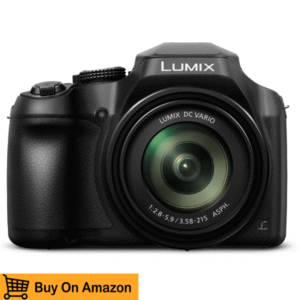
This is a point-and-shoot long zoom camera featuring an 18.1 megapixel MOS sensor and a 60x zoom DC Vario lens (20-1220mm) with Optical Image Stabilizer. It includes a high-resolution 1,170K dot viewfinder and a 3-inch LCD display with touch functionality for clear viewing even in bright sunlight. The camera is capable of capturing 4K video (3840 x 2160) with various 4K photo modes for extracting high-resolution photos from video footage. It performs well in low-light conditions and offers USB charging and Wi-Fi connectivity for convenience during travel. Additionally, it provides multiple connectivity options including HDMI, Micro USB, and USB 2.0.
Product Overview:
The Panasonic LUMIX FZ80 4K Digital Camera is the perfect point–and–shoot camera for travelers and professional photographers alike. It features an 18.1 megapixel MOS sensor with 60X zooms DC Vario lens, optical image stabilization, a 1,170K dot viewfinder, and a rear touch-enabled 3-inch LCD Display. It has 4K QFHD video recording with three unique 4K Ultra HD video pause and saves 4K photo modes, allowing you to capture split-second moments.
It also has low light capture capabilities and USB charging and Wi-Fi connectivity to your mobile device. The LUMIX DC–FZ80K long zoom camera has a range of 20–1200mm (60X) LUMIX DC VARIO lens with a bright F2.8–5.9 aperture range that is optically stabilized with Panasonic’s POWER O.I.S. technology. The 4K video capture performance allows you to capture fast–paced action in stunning quality and create printable photos.
Post Focus and Focus Stacking allow for customizing the images with various focus points after taking the picture. With USB charging and Wi–Fi connectivity, you can enjoy travel–ready convenience. The Panasonic LUMIX FZ80 4K Digital Camera is the perfect point–and–shoot camera for travelers and professional photographers alike. Its long zoom camera capabilities, 4K video capture performance, low–light capture and USB charging, and Wi–Fi connectivity make it a great choice for capturing those special moments.
Whether you’re shooting landscapes or far–off moments, the FZ80 is perfect for capturing them in stunning quality.
- Long Zoom: 60x optical zoom and 20-1200mm lens make it perfect for capturing far-off moments.
- 4K Technology: 4K video capture and 4K Photo mode allow for stunning and detailed images.
- Image Stabilization: Power O.I.S. technology helps produce sharp and clear images.
- Touch-Enabled Display: Rear touch-enabled 3-inch LCD display is clear even in bright sunlight.
- Connectivity: USB charging and Wi-Fi connectivity allow for easy transfer of images.
- Low Light Performance: May have issues with capturing good images in low light conditions.
- Viewfinder: The viewfinder resolution is only 1,166k dots.
- International Compatibility: Products with electrical plugs are designed for use in the US and may require an adapter or converter for use in other countries.
2. Kodak PIXPRO Astro Zoom
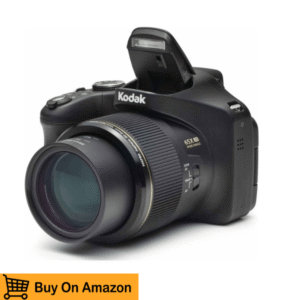
The Kodak PIXPRO AZ652 Astro Zoom Digital Camera bundle includes the camera itself along with additional accessories like a 32GB SDHC memory card, a battery, and a charger. The camera boasts an impressive 65x optical zoom, ensuring clear photos and HD videos even from a distance. It features burst shooting capability at 5 frames per second, ideal for capturing fast-moving subjects. Additionally, users can switch to RAW image format for more detailed editing options.
Product Overview:
The Kodak PIXPRO Astro Zoom AZ652–BK 20MP Digital Camera is a bridge camera that packs a punch. It comes with a 65x optical zoom lens, allowing you to get up close to your subjects and capture amazing detail. It also has a 3” LCD screen so you can review your shots and videos easily. With its 20MP resolution, you’ll get crystal clear images, and the ability to switch to RAW files gives you more options when you’re editing.
The AZ652 also has a few exciting features that help you capture even more. With 5 frames per second burst shooting, you have the ability to take multiple shots of a fast–moving subject, while image stabilization ensures that you’ll get sharp and clear photos, even when the action is happening in a hurry. Thanks to built–in Wi–Fi, you can easily share your photos and videos with friends and family.
This bundle also includes a Kodak 32GB Class 10 UHS–I U1 SDHC memory card and a Koah Rechargeable Battery and Charger Kit, so you’ll have everything you need to start taking amazing photos and videos. With the power of the Kodak PIXPRO Astro Zoom AZ652–BK, you can capture beautiful moments with remarkable detail.
- 20 MP effective still resolution
- 65x optical zoom
- Wi-Fi connectivity
- 3-inch screen size
- Burst shooting at 5 frames per second
- The limited video capture resolution (1080p)
- No mention of image stabilizationization
- The bundle only includes limited accessories (32GB SD card and battery/charger kit)
3. Sony Cyber‑Shot RX10 IV

This Sony camera boasts the world’s fastest autofocus acquisition speed of 0.03 seconds and features optical image stabilization technology for steady handheld shooting, especially in low light or at high zoom levels up to 600mm. It includes 315 phase-detection autofocus points covering approximately 65% of the frame, along with a ZEISS Vario-Sonnar T 24-600mm ultra-zoom lens.
The camera utilizes a 20.1 MP 1″ back-illuminated Exmor RS stacked CMOS sensor with DRAM, enabling continuous shooting at 24 frames per second for up to 249 frames with autofocus and auto-exposure tracking. The camera weighs approximately 2 pounds 6.7 ounces (including battery and SDXC card) and supports a filter diameter of 62mm.
Product Overview:
The Sony Cyber–Shot RX10 IV is a powerful and versatile ultra composite digital camera. It offers a 20-megapixel resolution, 25x optical zoom, and a 7.5-inch LCD screen. It also has advanced features such as Bluetooth and Wi–Fi connectivity. The world’s fastest auto–focus acquisition speed of 0.03 seconds and up to 24 frames per second of continuous shooting make it perfect for imaging enthusiasts and professionals.
The camera boasts a 1–inch back–illuminated Exmor RS stacked CMOS sensor that enhances efficiency and speed of A/D conversion, as well as a stunning 20.1–megapixel resolution. The ZEISS Vario–Sonnar T 24–600mm3 F2.4–F4 ultra–zoom lens is perfect for capturing sharp and high–quality images with a minimum focusing distance of 2.36 ft. and 0.49x maximum magnification. Optical SteadyShot image stabilization also helps reduce blur and enhance the sharpness of handheld shots.
The Sony Cyber–Shot RX10 IV is a great choice for photographers looking for an all–in–one camera solution. Its fast focus and high-speed continuous shooting will make it easier to capture amazing images in any situation, while its 1–inch image sensor and 24–600mm lens offers unparalleled quality. With Bluetooth and Wi–Fi connectivity, the RX10 IV is a great choice for the modern photographer.
- Fast autofocus acquisition speed of 0.03 seconds
- Versatile 25x optical zoom
- The high image resolution of 20.1 MP
- Fast continuous shooting up to 24 fps with full AF/AE tracking
- A stacked CMOS sensor with a DRAM chip enhances speed and efficiency
- Expensive compared to other similar models
- May require an adapter or converter for use internationally
- A weight of 2.6 pounds may be heavy for some users
4. Minolta M35Z 20MP 1080p Best bridge camera for birding
The Minolta M35Z Bridge Camera is a versatile camera that comes with various accessories including a USB cable, AC adapter, neck strap, pouch, and more. It features a 20MP sensor for capturing high-resolution still photos and can record 1080p HD videos. With built-in Wi-Fi, users can use their smartphones as a remote shutter and easily transfer photos between Wi-Fi-enabled devices. The camera also offers a 35x optical zoom, allowing users to capture detailed shots from a distance.
Product Overview:
The Minolta M35Z Bridge Digital Camera is a powerful and versatile device that is perfect for capturing life’s special moments. This 20MP camera has an impressive 35x optical zoom lens that lets you get up to 35 times closer to your subject for maximum clarity and detail. The 1080p HD video recording capability ensures that your videos come out with stunning vividness and clarity.
The M35Z also features image stabilization to reduce blur and jitter, and built–in Wi–Fi that makes it easy to transfer photos and videos to other compatible devices. This camera also comes with a bundle of accessories that includes a camera case, 16GB SDHC card, memory wallet, cleaning kit, card reader, and tabletop tripod. The M35Z is designed to be user–friendly and easy to use, even for novice photographers. It has a large 3.0” LCD display that makes framing, reviewing, and editing your photos and videos easier.
The customizable settings allow you to take control over the look of your photos and videos and get the perfect shot. The included lithium-ion battery ensures that you will never miss a moment of your shooting. Plus, the camera is backed by a Minolta 1 Year Warranty. If you are looking for a powerful, versatile, and easy-to-use camera, the Minolta M35Z Bridge Digital Camera is a perfect choice. With its 20MP resolution and 35x optical zoom, you are sure to capture stunning, high–quality photos and videos.
The included accessories and user–friendly features make it a great choice for novice and experienced photographers alike.
- 20 MP effective still resolution for high-quality photos
- 1080p HD video recording
- Built-in Wi-Fi for easy transfer of photos
- 35x optical zoom for versatility in capturing subjects at different distances
- The bundle comes with various accessories like a camera case, memory wallet, and cleaning kit
- No mention of image quality in low-light conditions
- No mention of touch screen or manual control options
- No mention of weather sealing or durability features
5. Canon Powershot SX70
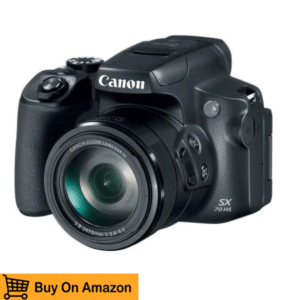
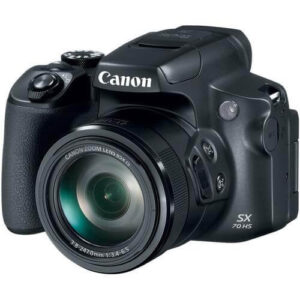
The Canon camera offers a powerful 65x optical zoom and features a 20.3-megapixel CMOS sensor paired with a DIGIC 8 image processor for high-quality image capture. It can record 4K video and 4K time-lapse movies. The camera includes a 0.39-Type OLED electronic viewfinder (EVF) with approximately 2.36 million dots. Additionally, users can utilize the EOS Utility Webcam Beta Software on both Mac and Windows systems to convert their compatible Canon camera into a high-quality webcam.
Product Overview:
The Canon Powershot SX70 is a powerful 20.3MP digital camera that packs a punch with its 65x optical zoom lens and 4K video. It offers amazing versatility and range with its wide–angle 21mm–1365mm lens, Optical Image Stabilizer, and High–Sensitivity CMOS Sensor. The camera’s DIGIC 8 image processor enables excellent low–light performance, and its 039–type OLED EVF makes it easy to track and capture long shots.
It also features advanced features such as Zoom Framing Assist and Intelligent IS to help users capture steady, clear images. The camera’s 4K video and 4K time–lapse movie capabilities allow users to shoot realistic videos, and they can quickly share whatever they capture with Wi–Fi and Bluetooth-enabled devices. In addition, the EOS Utility Webcam Beta Software makes it easy to turn the camera into a high–quality webcam for Mac and Windows computers.
The Canon Powershot SX70 offers users an incredible range of features, making it an ideal choice for capturing far–away subjects, beautiful landscapes, and long–range shots. With its cutting–edge features, impressive zoom range, and excellent low–light performance, this camera is sure to please any photography enthusiast.
- High effective still resolution of 20.3 MP.
- Powerful 65x optical zoom lens.
- 4K video and 4K time-lapse movie capabilities.
- OLED EVF with approximately 236 million dots.
- Wi-Fi and Bluetooth enabled with an EOS-like user interface design.
- May not have the same level of low-light performance as a full-frame camera.
- No mention of image stabilizationization.
- Only a 3-inch LCD tilt screen.
6. Minolta MN67Z 20MP Best bridge camera for beginners
The Minolta MN67Z Bridge Camera is a versatile camera with a powerful 67x optical zoom and a 20MP sensor for capturing high-resolution images and full HD videos. It features built-in Wi-Fi for easy connectivity, and this essential bundle includes various accessories such as a 16GB SDHC card, USB cable, AC adapter, neck strap, lithium-ion battery, CD-ROM, 64GB SDXC memory card, shoulder bag, Ulanzi octopus tripod, cleaning kit, card reader, memory wallet, and Corel PC software suite. The camera comes in a stylish purple color and is backed by a 1-year limited warranty from Minolta.
Product Overview:
The Minolta MN67Z 20MP Full HD Wi–Fi Bridge Camera with 67x Optical Zoom is an essential bundle for any aspiring photographer. It’s powerful 67x optical and 4x digital zoom capabilities make it ideal for capturing long–distance shots and close–ups in crisp detail, while its image stabilization feature helps keep images steady when camera shake is detected.
The user–friendly features such as the face, smile, and blink detection allow you to capture the perfect photo, and the variety of scene modes including Night Portrait, Panorama, and Sunset make shooting in any setting easy. This bundle also includes a 16GB SDHC Card, USB Cable, AC Adapter, Neck Strap, Lens Cap, Lithium-Ion Battery, CD-ROM, Minolta 1 Year Limited Warranty, 64GB SDXC Memory Card, Shoulder Bag, Ulanzi Octopus Tripod, Cleaning Kit, Card Reader, Memory Wallet, and Corel PC Software Suite.
This camera is also extremely versatile, with a 1080p Full HD Video that can shoot crystal–clear high-definition videos in 16:9 widescreen format at a frame rate of 30fps. The 20.0 Mega Pixels Photo Resolution sensor allows you to create everlasting moments with stunningly high–resolution images that are suitable for cropping/enlarging without losing image quality. The generous 3.0–inch Articulating LCD Display with an amazing 920K resolution makes it easier to frame & capture shots, read menus, and view images on a bright, clear display.
The Minolta MN67Z 20MP Full HD Wi–Fi Bridge Camera with 67x Optical Zoom is the perfect bundle for any photography enthusiast looking to take their work to the next level. With its powerful digital and optical zoom capabilities, Full HD video, and 20.0 Mega Pixels Photo Resolution, this camera is sure to give you the shots you’ve been looking for. This essential bundle also includes a variety of accessories to make sure you have everything you need to succeed in the field.
- 67x Optical Zoom Lens
- 20 MP Full HD Resolution
- Wi-Fi connectivity
- Face, smile, and blink detection
- 3.0″ 920k Articulating LCD with angle adjustment
- Products with electrical plugs designed for use in the US only
- May require an adapter or converter for international use
- May have limited compatibility with older devices and operating systems
7. Minolta Pro Shot 20 Mega
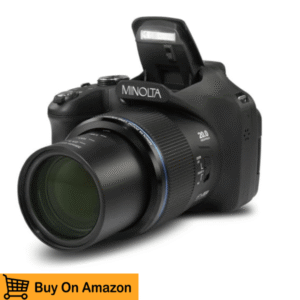
The camera features a 20-megapixel CMOS sensor and a powerful 67x optical zoom, allowing users to capture sharp images and full HD (1080P) video. It comes with a 3-inch LCD display and includes various shooting modes such as 14 scene modes, face detection, smile detection, blink detection, photo touch-up, continuous shooting mode, 360° panorama shooting, and built-in flash with red-eye reduction.
Additionally, it features optical image stabilization and high dynamic range (HDR) for improved image quality. The lens type is telephoto, providing versatility in capturing distant subjects.
Product Overview:
The Minolta Pro-Shot 20 Mega Pixel HD Digital Camera with 67X Optical Zoom is a point-and-shoot camera that is sure to capture all of your precious memories. It has a 20 MP effective still resolution and 27 intelligent shooting modes, as well as a 67x optical zoom and full 1080p HD video. In addition, it has a 3“ LCD display, 14 scene modes, and a built–in flash with red–eye reduction.
This camera is perfect for capturing the perfect shot, thanks to its Wi–Fi connectivity, optical image stabilization, and 360° panorama shooting features. This camera is also equipped with a 1/2.3–inch photo sensor, allowing you to take sharp images with stunning detail. The 16GB SD card that comes with the camera is great for storing all of your photos and videos without worry. Plus, the camera comes with a range of photo touch–up options and a continuous shooting mode that is ideal for capturing fast action shots.
The Minolta Pro-Shot Digital Camera is a great choice for any photographer, amateur or professional. It is easy to use, has a wide range of features, and is sure to capture all of your special moments. Plus, no matter what your destination may be, the camera is designed to be compatible with different outlets and voltages. With this camera, you can capture and preserve all of your special moments with ease.
- 20-megapixel CMOS sensor for high-quality images.
- 67x optical zoom lens with optical stabilization for sharp and clear photos.
- Wi-Fi connectivity for easy transfer and sharing of photos and videos.
- 3″ LCD display for easy framing and reviewing of images.
- Various shooting and scene modes for different lighting and shooting conditions.
- The camera may require an adapter or converter for use in international destinations due to differences in outlets and voltage.
- It’s not clear what the photo touch-up feature is or how it works.
- It is not specified if the camera has built-in storage.
8. Canon Powershot SX70 Best bridge camera for wildlife
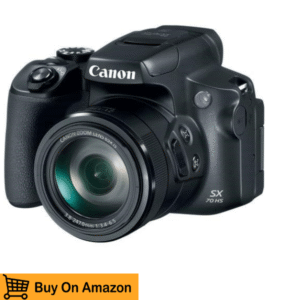
The Canon camera offers a powerful 65x optical zoom and features a 20.3-megapixel CMOS sensor paired with a DIGIC 8 image processor for high-quality image capture. It can record 4K video and 4K time-lapse movies.
The camera includes a 0.39-Type OLED electronic viewfinder (EVF) with approximately 2.36 million dots. Additionally, users can utilize the EOS Utility Webcam Beta Software on both Mac and Windows systems to convert their compatible Canon camera into a high-quality webcam.
Product Overview:
The Canon Powershot SX70 is a highly versatile digital camera that is ideal for a wide range of photography needs. Its 20.3 Megapixel High–Sensitivity CMOS sensor and Canon‘s latest DIGIC 8 image processor make it great for low–light photography and capturing detailed images. The camera also features an impressive 65x optical zoom lens, allowing you to capture close–up shots of distant objects.
Additionally, the SX70 is equipped with 4K video and 4K time–lapse movies, allowing you to capture stunning videos of your travels. The SX70 features a 3–inch LCD tilt screen that lets you easily adjust the camera angle. It also has an OLED EVF with a 039–type and approximately 236–million dot resolution that makes it easier to see through the viewfinder. Additionally, the camera has built–in Wi–Fi and Bluetooth connectivity, making it easy to share your images and videos quickly with friends and family.
The SX70 is designed for ease of use and its EOS–like user interface makes it intuitive for even novice photographers. Its advanced technology such as zoom framing assist and intelligence helps you track and capture clear, steady long shots. Plus, with the Canon EOS Utility Webcam Beta Software, you can easily turn your Canon camera into a high–quality webcam. With the Canon Powershot SX70, you will be able to capture stunning photos and videos with ease.
- Powerful 65x optical zoom with optical image stabilizer
- 20.3 megapixel high-sensitivity CMOS sensor with the latest DIGIC 8 image processor
- 4K video and 4K time-lapse movie capabilities
- OLED EVF (Electronic View Finder) with approximately 236 million dots
- Wi-Fi and Bluetooth enabled with an easy-to-use EOS-like user interface.
- May require an adapter or converter for use in other countries due to differences in electrical outlets and voltage.
- No mention of built-in flash.
- No mention of built-in image stabilization technology.
9. Panasonic Lumix FZ1000 4K Best superzoom camera

The Panasonic LUMIX FZ1000 is a powerful camera that offers true-to-life 4K video recording at 30p and hybrid 8MP post-capture capabilities. It features a 1-inch 20.1-megapixel High Sensitivity MOS Sensor for clear images with minimal noise, even at high ISO settings. The camera includes a LEICA DC Lens with a focal length range of 25-400mm, featuring advanced autofocus technology with a fast response time.
It also comes with integrated smartphone WiFi for remote control, a 0.39 OLED LVF Live Viewfinder, and a 3.0 Free-Angle TFT Screen LCD. This bundle includes various accessories such as a photography equipment bag, UV, polarizer & FLD filter kit, memory card, tripod/grip, dust blower, lens cap keeper, LCD screen protectors, memory card reader, and photo and video editing software.
Product Overview:
The Panasonic Lumix FZ1000 is a powerful point-and-shoot camera designed for the photography enthusiast who wants to capture stunning images with ease. This digital camera features an impressive 16x Leica DC Vario–Elmarit 25–400mm lens, 20.1MP image resolution, and image stabilization to ensure crisp images.
Additionally, this camera comes with a variety of connectivity options, including Wi–Fi and USB, and a 3–inch LCD monitor. The Panasonic Lumix FZ1000 also comes with an impressive 1–inch, 20.1–megapixel High Sensitivity MOS Sensor, which improves the S/N ratio and allows you to capture clear images even when shot at ISO12800 and extended ISO25600. The Leica DC Lens (F2.8–4.0 25–400mm) with 15 elements in 11 groups, including 4 ED lenses and 5 aspherical lenses with 8 aspherical surfaces, adds to the camera’s impressive features.
This camera also features Light Speed Autofocus AF with LUMIX DFD Focus Technology and HYBRID O.I.S. (Optical Image Stabilizer) + with 5–Axis Correction for steady and blur–free images. The Panasonic Lumix FZ1000 also comes with a host of accessories, including a Deco Gear Photography Equipment Bag Travel Case, a 62mm UV, Polarizer & FLD Filter Kit, a Lexar Professional 633x 64GB UHS–1 Class 10 SDXC Memory Card, a 12” Rubberized Tripod/Grip, a Dust Blower, and a Lens Cap Keeper.
Plus, you’ll also get a variety of photo and video editing software, including Aurora HDR Advanced Photo Editor, Photo Noir, Video Suite, Slideshow Maker, Photo Editor 5, Photo Focus, DeNoise, piZap Pro, and OfficeSuite.
- 4K video recording capability with smooth motion
- 20.1 megapixel MOS sensor for improved image quality and low noise
- Bright Leica DC lens with 16x optical zoom
- Super-fast focusing technology for quick shots
- Integrated Wi-Fi for remote control
- A large form factor may not be suitable for compact travel
- No built-in image stabilization in the lens
- May require an adapter or converter for international use
Just like that of the compact cameras, the zoom lens of the bridges is fixed; unlike reflex and mirrorless, therefore, it is not possible to replace it with another lens.
From an aesthetic point of view, bridges generally appear very similar to reflex cameras but are normally smaller in size. There is usually a fairly pronounced grip, a small physical dial that allows you to change some settings, and a shooting mode dial.
As for the methods of use, more space is often left to automatisms than to the creativity of the photographer. It is generally possible to intervene in the management of exposure and depth of field, but not with the same freedom offered by interchangeable lens cameras. For example, in budget models, the range within which an aperture can be chosen is often limited to just 2/3 stops.
Some of the best medium / high-end bridges, not surprisingly aimed at the most experienced, instead allow you to set all the shooting parameters without any constraints, as well as to perform long exposures and apply filters to the lens.
Even from the point of view of image quality, the bridges cannot compete with the most advanced reflex and mirrorless cameras. The cheaper models offer a level of detail very similar to that typical of compact and only slightly higher than that of smartphones.
Some more advanced models, those with 1 ″ sensor, provide a higher image quality (however not at the level of interchangeable lens cameras), but on the other hand, they often have a price much higher than that of an SLR entry-level with a standard lens.
Best Bridge Cameras: the Most Important Features

We explained how bridges are characterized by an extremely powerful zoom: usually, their characteristics are summarized simply by the number of “per” (like 40x or 60x), which indicates its range.
In truth, however, there is much more to say about a camera lens, especially if it is a bridge type.
Equivalent focal

The equivalent focal length, measured in millimeters, is the parameter that indicates in a “scientific” way what the amplitude of the framed scene will be, understood as the angle of view.
When we shoot a very wide scene, such as a landscape, we are using a short equivalent focal length (for example 24mm), which corresponds to a wide-angle of view. When we “zoom a lot” on a distant subject we are doing nothing but reducing the framed angle of view and we are using a high equivalent focal length (such as 200mm, 500mm, or more). If you want to learn more about this topic, we recommend that you read the page dedicated to the objectives.
It is precisely in the area of long focal lengths that bridge cameras give their best; let’s try to clarify by giving some practical examples.
Animals in the wild are among the subjects that require the most extreme focal lengths given that, for obvious reasons, one cannot get close to them that much. The photos of birds in flight and animals in their habitat that we can admire on the photography forums are in fact normally taken with powerful telephoto lenses.
Typical focal lengths for this kind of photograph are around 500mm or 600mm equivalent, sometimes 800, but are rarely longer.
Yet, almost all the best bridge cameras that we will present to you later reach at least the focal length of 600mm and most of the models go far beyond, touching the equivalent 1,200-1,400mm or even more.
The image below takes as an example a subject familiar to everyone, the moon, and shows the level of magnification that can be achieved with focal lengths of this type.
This is clearly a simulation that we made starting from a single shot, but the area occupied by the moon with respect to the entire frame is reported in a very precise way.
Notice how at 2000mm our satellite almost completely fills the frame: a very illustrative example of the zoom potential in this type of camera.
In terms of maximum focal length, the bridges do not, therefore, seem to have rivals. Even the minimum focal length, however, is a parameter to be taken into strong consideration, especially if you often photograph landscapes and large scenes in general.
In truth, on this point, the models we have considered in our ranking of the best bridges do not differ that much: we almost always start from 24mm equivalent. However, some cameras are an exception and offer a shorter minimum focal length.
The image below shows the same scene framed with a focal length of 20 and 24 millimeters equivalent. It is evident that in the first case the “room for maneuver” is far greater!
The focal range simply indicates the ratio of the maximum to the minimum focal length covered by a zoom lens. In practice, it is nothing more than the number of “for” highlighted in the technical data sheet of the cameras and often stamped directly on their body.
Brightness (Aperture)

The zoom we have referred to so far is the optical one, which generates magnification through the movement of the lenses inside it. Amateur cameras also often integrate a digital zoom, which promises to further increase the range of the lens.
With this type of zoom, however, the enlargement is obtained simply by “dilating” the central area of the frame: the level of detail remains unchanged while the image quality dramatically worsens. Since it is a useless feature, as well as misleading, we have chosen not to mention it at all in the cards of the best bridges on this page.
If the lens represents the eye of a camera, the sensor can be called its “heart”. The performance of the machine in terms of image quality and resistance to high sensitivities largely depends on this component.
The digital sensors used today correspond to certain standard formats and the main difference between one and the other is the physical size. Generally speaking, the larger a sensor the better the image quality .
In the image above you will find a schematic comparison between the dimensions of the various sensors used on modern digital cameras (of any type).
Only the two smaller formats are used on bridge cameras: the 1 / 2.3 “ and the 1″ . In particular, the cheaper bridges all have a 1 / 2.3 “sensor (the same as the low-end compacts) while only some of the more advanced models have a 1” sensor.
Although in no case can these sensors compete with those available to reflex and mirrorless cameras, the difference between the two standards is quite evident.
If for you image quality (understood as the level of detail, sharpness, and color fidelity) is essential, we, therefore, advise you to choose models with a 1 ″ sensor.
From the 1 / 2.3 ″ sensor bridges you can expect quality similar to that of the economic compact, which does not differ too much from that offered by medium / high-end smartphones.
On the other hand, as you may have guessed by now at this point of the guide, the strength of bridges is not the quality, but the power of the zoom and versatility in general.
The resolution is the size of the photos that can be taken with a particular camera and is measured in megapixels, or in millions of pixels. In other circumstances, we have warned a little about the exceptionally high resolutions touted by some cameras. In fact, all too often an exaggerated number of pixels results in a lower level of detail at maximum magnifications.
When it comes to the best bridge cameras we’ve reviewed, however, there aren’t any major differences from one model to another. The resolution generally fluctuates between 16 and 20 megapixels, adequate values for any amateur use and consistent with the possibilities offered by a small sensor.
Manual Controls